Overview
Project 1
A scalable, distributed spectrum enforcement is proposed in which sensor reputation is used as a form of "currency" . Challenges related to sensor trust and geographical scalability are addressed by partitioning a region into grids, each maintained by an immutable "Localchain". A novel Performance-Based Difficulty Consensus (PBDC) is introduced, featuring adaptive mining difficulty adjusted based on a validator’s qualification score and observed grid hostility. This ensures high-integrity enforcement in a zero-trust environment without the need for a central authority using blockchain.
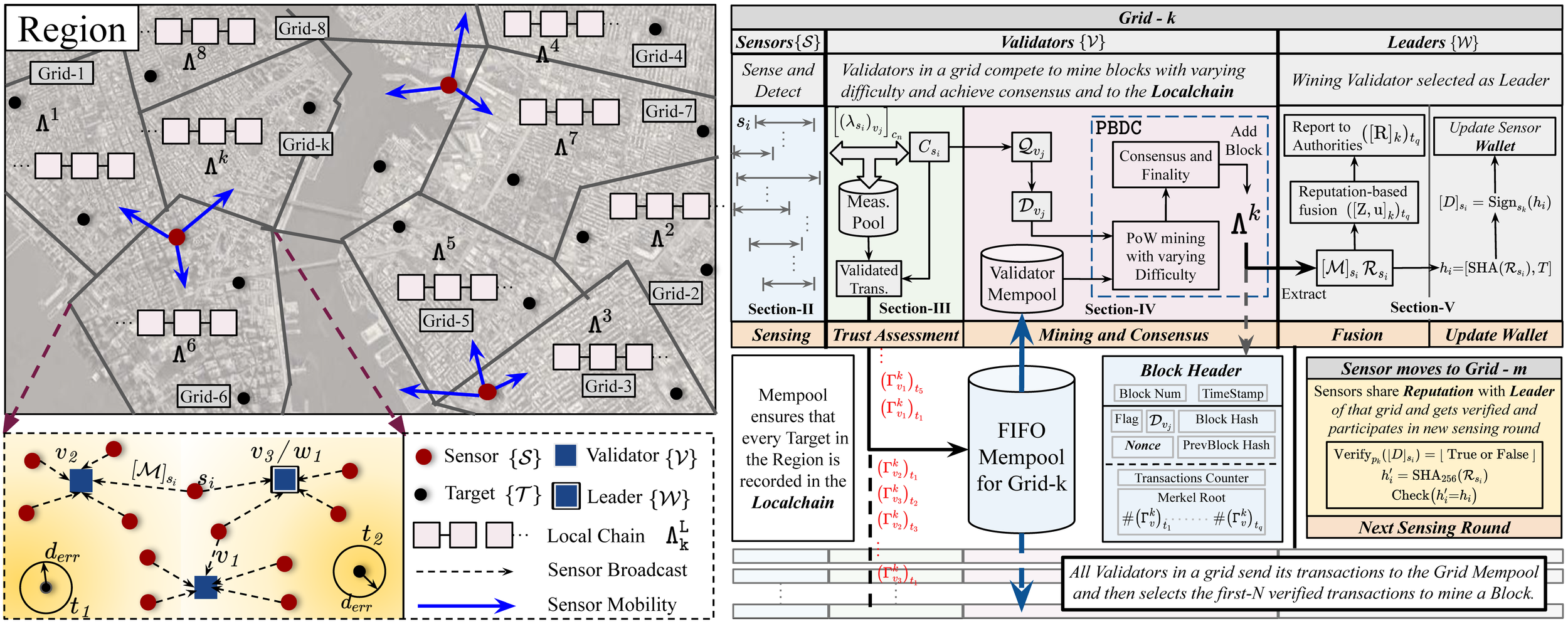
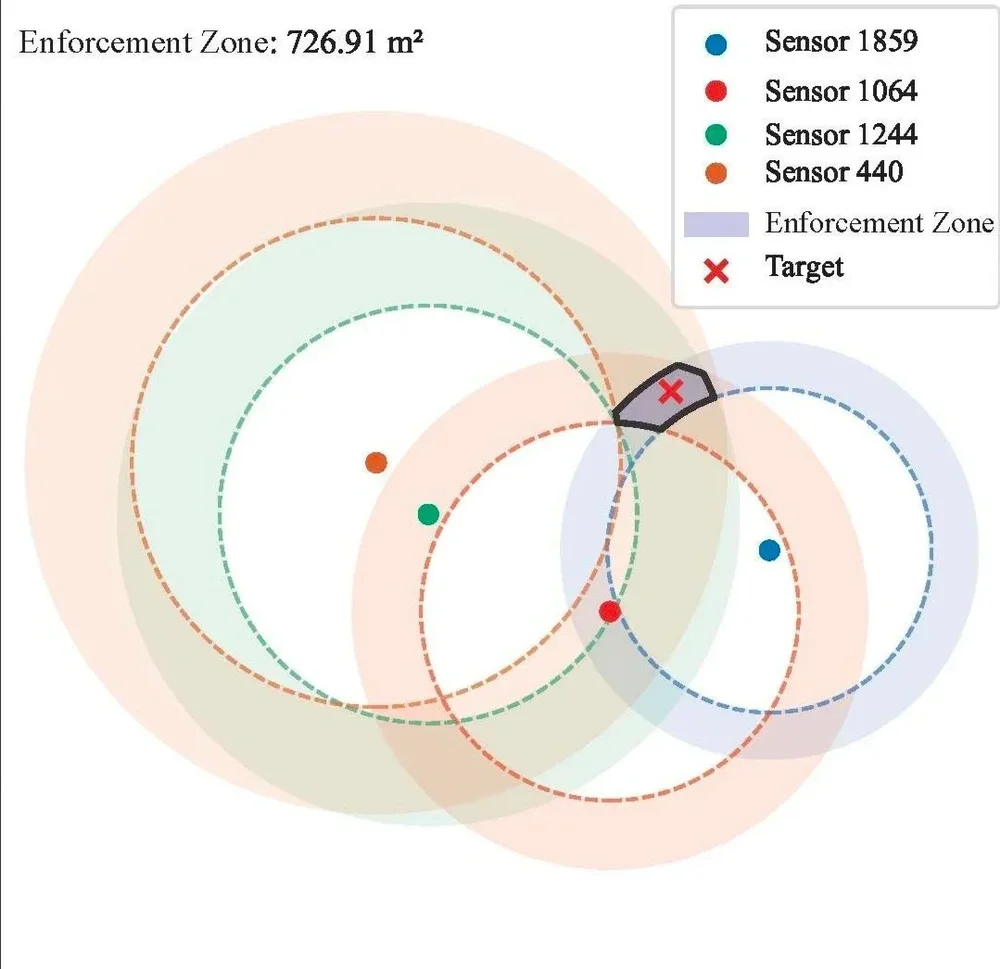
Target localization is initiated by aggregating sensor evidence, which is converted via the Hata model into annular regions. The intersection of these regions defines the Enforcement Zone (ZoE), with accuracy maintained by mitigating noise and Geometric Dilution of Precision (GDOP).
By aligning shard boundaries with wireless signal footprints, topological sharding eliminates cross-shard overhead and prevents data fragmentation. In shards, local consensus is achieved via a quality-aware DPoS mechanism, where voting weight is determined by the precision of the ZoE. Regional decisions are finalized using a novel dynamic ZoE-based PoW. This design enables the scalable, fast, and auditable recording of spectrum violations.
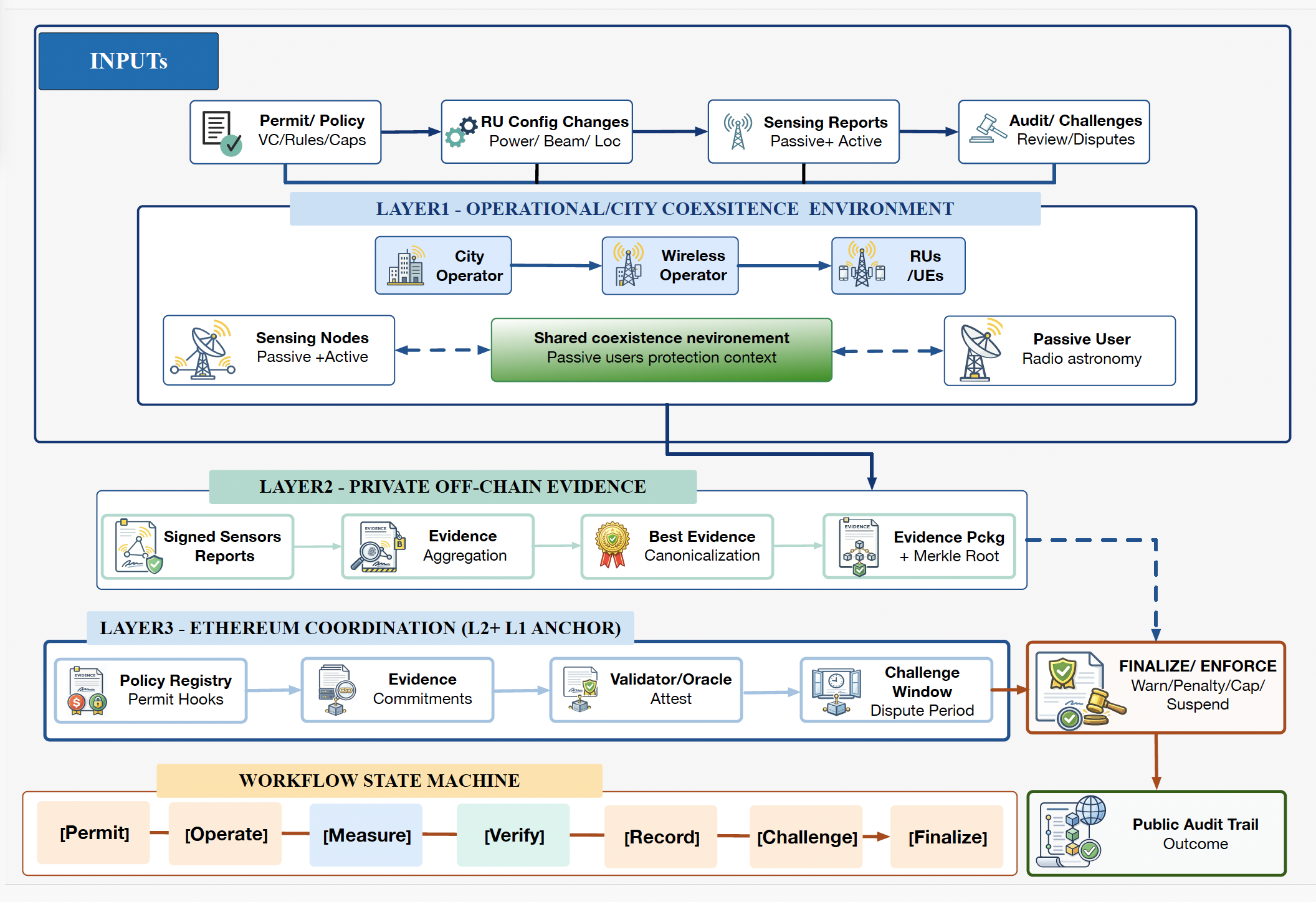
The blockchain layer provides the tamper-evident coordination and audit for spectrum enforcement. In each round, validators submit compact enforcement records that encode an RU’s estimated transmit-power behavior and reference the associated evidence through an integrity commitment. Full sensor reports and raw RF traces are retained off-chain, while only hashes and Merkle roots are recorded on-chain, reducing storage overhead and gas consumption.
Record finalization follows a batched challenge process: proposed outcomes remain provisional until block-level checks, validator attestations, and any dispute handling are completed. Only then are outcomes finalized and written as durable enforcement records. This architecture supports scalable and low-cost enforcement while preserving auditability, due process, and trust in the recorded result.
Project 3
Project 2
Distributed applications over an unguided medium, such as wireless signals, are inherently unstable and unreliable from a communication perspective. Therefore, with the proliferation of Wireless IoT (W-IoT), building zero-trust systems without a central authority and management becomes very difficult and sometimes impossible.
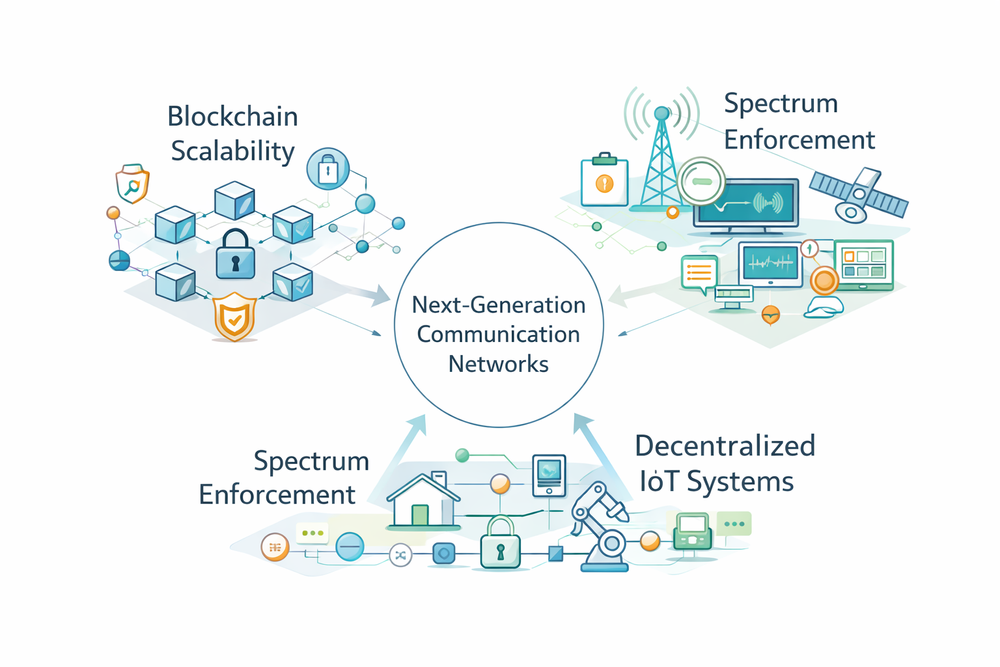
I view this problem space as very exciting and technically challenging at the intersection of blockchain, spectrum enforcement, and decentralized IoT systems. Each project represents an effort to deliver secure and efficient solutions for next-generation communication networks. The projects I have worked on are listed below.